An operational, scalable and reliable IT service model for businesses
For modern businesses, IT infrastructure is no longer just computers, servers, and networks. Today, technology is the backbone of all business operations, from sales to customer service, from internal communications to data security. Therefore, it is not enough to “solve a technical problem someday.” The main issue for companies is how long it will take to accept the problem, who will implement it, what priority will be given to it, and how to measure the result. This is where Technical support with SLA concept comes to the fore.
SLA – Service Level Agreement, that is, service level agreement. Simply put, this is a working service model that predetermines the rules of technical support service, response times, escalation mechanism, division of responsibility and performance indicators. The SLA approach is also widely used in international IT Service Management practices. For example, general information about the ISO/IEC 20000 standard on service management On the official ISO website It is possible to read.
Why is technical support with SLA important?
In the traditional technical support model, the process is often unclear after a problem occurs. Who was the request sent to, when will it be reviewed, is the issue critical or queued? This uncertainty means wasted time for the business, internal dissatisfaction, and operational downtime.
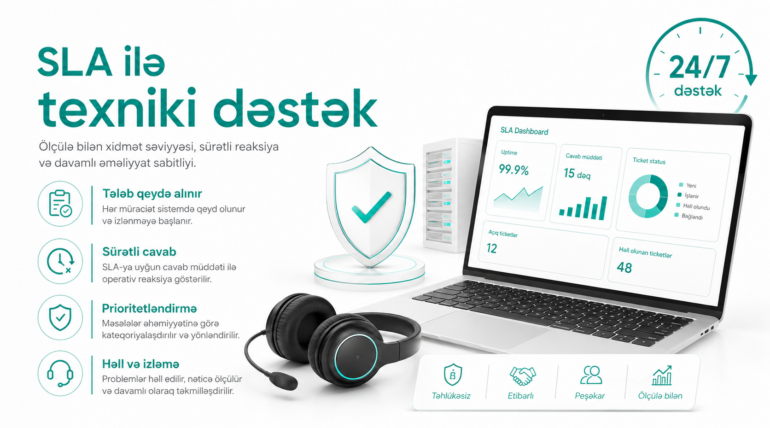
Technical support with SLA systematizes this process. Each request is registered, categorized, and prioritized. For example, a user's printer problem is not evaluated at the same level as an entire office's internet connection outage. Critical incidents are escalated faster, while low-priority requests are handled in a planned manner. This approach creates transparency for both the IT team and business management.
Response time and resolution time are not the same thing
One of the most confusing concepts in the SLA model is the difference between “response time” and “resolution time.” Response time refers to how quickly a technical team responds to a request. Resolution time refers to the time it takes to fully resolve a problem. For example, a critical server issue may be resolved within 15 minutes, but a full resolution may require additional diagnostics, backup checks, and system recovery.
Microsoft Learn provides helpful explanations on how to read and properly understand SLAs: Concept of Service-Level Agreement. These types of approaches show that an SLA is not just a promise of “we will respond quickly”, but a measurable service commitment.
Key benefits for business
Technical support with SLA provides the company with a predictable service quality first and foremost. Management knows how a critical system problem will be handled. Employees know that requests are not lost and are registered with a traceable ticketing process. The IT service provider, on the other hand, manages the workload, resource allocation, and priorities more professionally.
This model is particularly effective for office IT infrastructure, server and network management, cybersecurity monitoring, backup processes, endpoint support, and user request management. NIST's approach to incident management Computer Security Incident Handling Guide The document also shows that a systematic process of preparing, analyzing, and responding to technical incidents is an essential part of a resilient IT environment.
How does SLA make technical support more professional?
SLA allows for metric-based, rather than emotional, management of service. Here, elements such as uptime, incident response, escalation path, ticket lifecycle, preventive maintenance, reporting, and root cause analysis come to the fore. In other words, technical support is no longer just a reactive function that solves problems; it becomes a proactive management mechanism that maintains business continuity.
This approach is even more important in the B2B sector, as every outage impacts sales, customer experience, reputation, and internal productivity. A technical support model driven by SLA helps mitigate risks, measure service quality, and make IT costs more manageable.
If stable operation of IT systems, prompt response to problems, transparent accountability, and professional service management are important to your company, Technical support with SLA is no longer an option, but a necessity. This model increases the technological resilience of your business, simplifies the work of internal teams, and maintains the continuity of critical processes.
B2B Group We help you manage your business's IT infrastructure in a more systematic, secure, and measurable way.
If you want to move your technical support processes to a professional SLA-based model, contact us and let's build the right IT support solution for your business together.
One thought on “SLA ilə texniki dəstək | B2B Group IT xidmətləri”
Comments are closed.