Slow network speeds, unstable connections, or occasional packet loss are not always caused by a switch, router, or ISP. The source of the problem is often the physical cabling infrastructure. Especially in large offices, data centers, and structured cabling systems, small installation errors can quickly turn into serious performance issues.
Fluke testing allows you to determine not only whether a cable line is working, but also whether it meets the required performance and standard specifications. “What is the Fluke test for?” Our article also explains how Fluke testing helps assess system reliability.
What cable problems can the Fluke test detect?
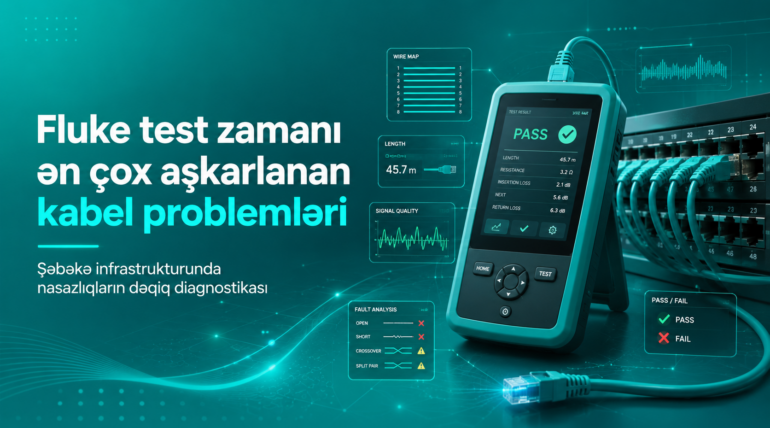
Professional Fluke cable testing measures several important parameters of the cable line. The test result can determine not only the “PASS” or “FAIL” status, but also the nature of the problem and, in some cases, where in the cable it originated.
Wiremap errors and incorrect termination
Wiremap testing checks whether the wires inside the cable are connected to the correct pins. Problems such as open circuit, short circuit, reversed pair, and split pair are mainly caused by improper termination of connectors or patch panels.
Some of these errors may be immediately apparent on a simple connection. Others cause performance degradation even when the network is working. Therefore, just because a cable “transmits” a signal does not prove that it is installed correctly.
NEXT – signal interference between cable pairs
NEXT – Near-End Crosstalk – measures the electromagnetic effect that a signal on one cable pair has on the other pair.
An abnormal NEXT reading can be caused by excessive opening of the pairs in the connector, poor quality components, or improper assembly. In practice, this type of problem can result in packet loss, unstable connections, and reduced performance at high speeds.
Fluke Networks notes that parameters such as NEXT in cable diagnostics are key indicators in the certification process.
Return Loss – signal reflection back
Return Loss indicates how much of the signal is reflected back as a result of impedance mismatch in the cable line.
This problem can be caused by a faulty connector, poor quality cable, mechanical damage, or excessive bending of the cable during installation. Poor Return Loss can degrade the overall performance of the line and cause a failed certification result.
Insertion Loss – signal loss along the cable
Insertion Loss measures how much the signal weakens as it travels along the cable.
Excessive cable length, poor quality patch cords, incorrect cable category, and poor connections can all contribute to this increase. According to Fluke Networks, excessive cable length and high impedance connections are among the causes of insertion loss.
Why isn't a simple cable tester enough?
A simple continuity tester basically shows whether the cable cores are physically connected to each other. However, it does not confirm that the line meets the performance requirements specified as Cat6 or Cat6A.
The professional Fluke tester measures the cable line, compares the results to specified standard limits, and can provide a technical report. This is especially important when commissioning a new structured cabling system and investigating unexplained performance problems in an existing network.
We carry out the construction of structured cabling and network infrastructures in various projects. For example, In the DOST project The structured cabling system we implemented was implemented to ensure a stable and reliable connection.
What does a Fluke test report provide to a business?
Fluke test reports provide a real-time picture of your cabling infrastructure with measurable metrics. This report can help you determine which lines are compliant, which cables are experiencing problems, and which parameters are out of range.
This approach allows us to pinpoint the source of a problem when a network problem occurs, rather than replacing random components. As a result, both diagnostic time and unnecessary maintenance costs can be reduced.
Identify exactly if there is a cable problem in your network
If you experience network speed loss, periodic connection drops, packet loss, or doubts about the quality of newly installed cable lines, it is not enough to identify the problem with a visual inspection alone.
With our Fluke testing service, you can professionally inspect your cabling infrastructure, pinpoint faults, and evaluate your network performance based on measurable results. For technical consultation on Fluke testing and cabling infrastructure contact us keep it.
SEE MORE: Call center solutions | Effective service model for business