
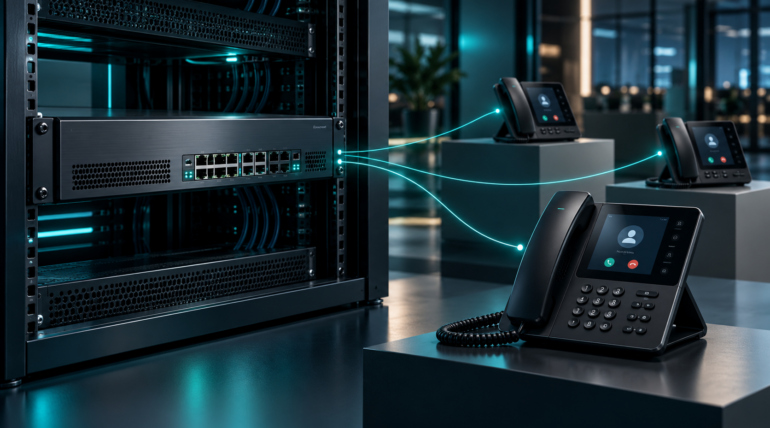
A phone call doesn’t necessarily mean a connection has been established. If a customer is looking for a sales representative, having them reach a technical support representative means additional waiting and re-explanation. If a call gets lost while being transferred to another desk, the company could lose a potential order. The quality of telephone communication is revealed precisely in these invisible links: where does the request go, who answers, and what happens if there is no answer?
How do corporate PBX systems handle calls?
A PBX is a telephone exchange that manages an enterprise's internal telephone network. It organizes internal calls between employees, receives external calls, and routes them based on defined rules. Thus, individual phones become part of a single company communication structure.
For corporate PBX systems, the key issue is not the number of telephones, but the logic of the calls. The number the customer dials, the business hours, the department they choose, and the availability of the employee can trigger different routes. A properly designed scenario routes the call to the address that can resolve the request, not to a random desk.
A journey within a rich company
Imagine a customer calling a company and hearing a short voice menu. They select the first button for sales and the second for technical support. This menu, called an IVR, determines the initial direction of the request. Here, clear options are more useful than a long presentation.
When sales is selected, the system transfers the call to the appropriate group. Depending on the configuration, the phones can ring simultaneously or sequentially. If all employees are busy, the request enters the queue. If the waiting time is exceeded, a forwarding to an alternative number or a voice message scenario can be applied.
The same call after business hours should be handled differently. Instead of a phone ringing in an empty office, the customer can get information about the work schedule. If there is a service on duty, the request is transferred to that team. These small rules form the impression of the company's accessibility.
The internal number and the external line are not the same.
There are two concepts that are often confused in design: the number of internal numbers and the number of simultaneous external calls. A company with fifty employees does not necessarily need fifty parallel external calls. On the other hand, a small sales team may have such an intensive call load.
The internal number identifies a specific employee or function. External call capacity is related to operator connectivity, system resources, and licensing conditions. Therefore, the need should not be calculated solely by looking at the employee list. Call flow during peak hours should also be measured.
In a modern IP PBX structure, communication with the operator can be organized via a SIP trunk. The suitability of this connection, parallel call capacity and numbering conditions should be clarified in advance with the operator. If existing analog devices are to be retained, the need for a suitable gateway is assessed separately.
The most expensive mistake is not considering the failure scenario
The phone system may be operational during a normal day. The real test begins when the power goes out, the operator connection is down, or the main server is unavailable. In such cases, it should be determined in advance how calls will be handled.
A backup power source, alternative connectivity, and a recovery plan address various issues. For example, a second internet line does not replace the power supply of a telephone exchange. The existence of a backup does not automatically guarantee its successful recovery. Testing should be conducted in accordance with the chosen architecture.
On the security side, unauthorized external calls are a separate risk. Restricting access to international destinations, strong account credentials, controlled access to the control panel, and notifications of unusual call activity should be considered.
The preservation of numbers during the transition should also not be overlooked. The use of the existing number in the new structure depends on the operator's capabilities and service conditions. Before the change, it is important to conduct test calls, check the internal numbers of departments and provide instructions for use to employees. The shutdown of the old system should be planned after the new scenarios have been approved. This preparation helps to preserve the use of contact numbers that customers know, if possible, and the team adapts more easily to the new rules. As a result, the transition is carried out in stages, taking into account the continuity of daily service.
Reasons are as important as the number of calls in the report
Receiving a hundred calls a day does not in itself indicate the quality of service. How many of them were answered? In which queue did customers wait the longest? At what times did requests go unanswered? The reporting capabilities of the chosen platform can help answer these questions.
For example, if there is an increase in missed calls during lunch hours, the first step may not be to purchase additional equipment. Changing the shift allocation and routing policy may be a more appropriate solution. The value of technical information is in translating it into everyday decisions.
Adapt your phone system to your workflow
Contact us Let's evaluate your existing phone infrastructure and call scenarios together. Contact us to plan a PBX solution that fits your team's work schedule, branch structure, and expected call load.
SEE MORE: Flexible work environment with unified communication solutions