
A customer calls the office number, and the employee who is supposed to answer is in a meeting. The other team member does not see the correspondence, and it takes several calls to reach the specialist in the branch. These delays, which seem small in isolation, accumulate throughout the day, taking up both the employee's time and not meeting the customer's expectations. When communication tools are combined into one system, daily work becomes clearer and more manageable.
What are unified communications solutions?
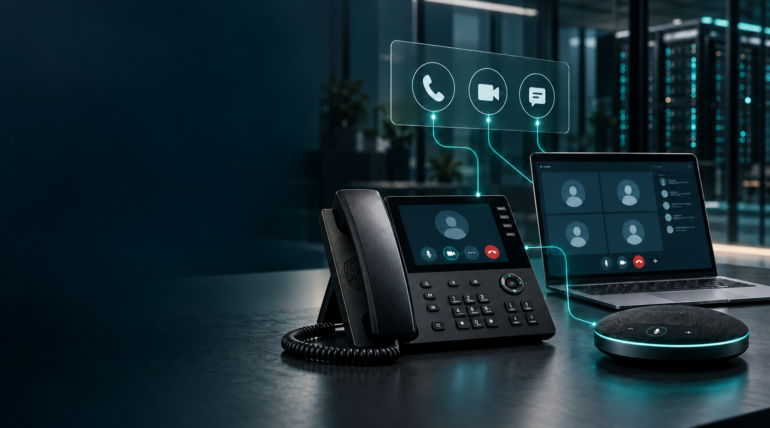
Unified communications solutions are an approach that combines corporate telephony, video calling, messaging, and employee availability status into a connected environment. The goal is not to give employees more software, but to make it easier for them to reach the right person through the right channel. Depending on the platform and integrations chosen, document sharing, meeting scheduling, and access to customer information can also be added to this environment.
For example, an employee sees that a colleague is busy and sends a message instead of a call. If the issue cannot be resolved through correspondence, the conversation is transferred to a video meeting. This reduces the need to search for a separate application and re-explain the information each time to continue the communication.
What problems does it solve for business?
One of the main advantages is the reduction of the dependence of the connection on a specific desk phone. In a properly configured system, an employee can receive corporate calls via a computer or a mobile application. This capability is especially useful for branches, mobile sales teams and hybrid businesses.
From a customer service perspective, routing calls to the right department, organizing queues, and tracking unanswered calls are important. For example, if a salesperson does not answer, the call can be transferred to another employee according to a pre-defined procedure. The need for the customer to redial the same number is reduced.
Internal collaboration is also more consistent. Project discussions are held in appropriate groups, meetings are scheduled, and team members see each other’s availability. However, the outcome is not just about the technology: the rules of use and the training of employees are also important.
What's happening on the technical side?
One of the main components of these systems is IP telephony. VoIP technology transmits voice over an IP network. The SIP protocol is used to create and manage call sessions between compatible systems. Simply put, voice transport and call setup are separate functions that complement each other.
However, fast internet alone does not guarantee quality voice. Network latency, packet loss, and variability in packet arrival times can cause voice degradation. QoS mechanisms help maintain voice quality during load times by prioritizing voice traffic on a managed network.
The design should assess the number of simultaneous calls, branch connectivity, wireless network status, and equipment to be used. Choosing a platform without checking the compatibility of existing phones can create additional costs later.
Cloud, on-premises, or hybrid model?
The cloud model involves the use of communication services over the provider's infrastructure. In the on-premises model, the main system is located on the enterprise's own infrastructure. In the hybrid approach, certain functions are shared between these two environments.
The choice should not be made automatically based on the size of the company. Data storage requirements, internet connection reliability, internal technical resources, and expansion plans should all be considered together. Calculating licensing, hardware, technical support, and migration costs in addition to the subscription fee creates a more realistic budget.
How should security and integration be built?
The communication infrastructure should also be included in the corporate security policy. User authorization and multi-factor authentication capabilities should be evaluated, and updates should be planned. In supported configurations, TLS is used to encrypt signaling, and SRTP is used to encrypt the voice stream. It should be checked separately on which connections the encryption works.
With CRM integration, it may be possible to open a customer card with an incoming call. However, such capabilities depend on platform compatibility, API capabilities, and licenses. Therefore, it is important to clarify the integration requirements before purchasing.
Where does proper application begin?
A successful transition begins with an analysis of existing communication processes. Which requests go unanswered? At what stage do employees waste time? Which departments are most in touch? These questions form the basis of the technical task.
Then, a pilot application is carried out with a limited group of users, call quality and routing rules are checked. Backup connection scenarios are tested, and employees are given practical training.
Results should also be monitored after implementation. The number of unanswered calls, average wait times, and user feedback indicate which parts of the system need to be improved. When these indicators are compared to the initial situation, it is possible to more clearly assess the impact of the investment on daily work. This approach can also help justify decisions during future expansion.
Build the right communication environment for your business
Contact us Let's assess your enterprise's communication needs together. Take the first step to selecting and implementing a solution that fits your existing infrastructure, security requirements, and growth plan.
One thought on “Vahid kommunikasiya həlləri ilə çevik iş mühiti”
Comments are closed.